
directed by Béné Meillon, Université d’Angers, France
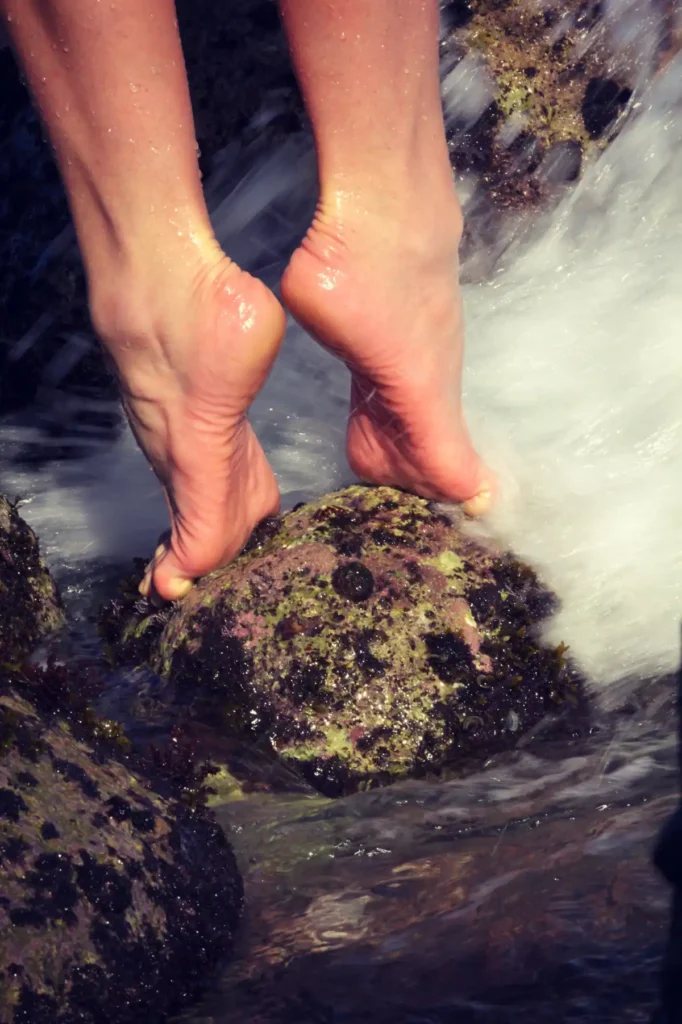
Dancing Bodies of Water is a research-creation project associated with the Sea More Blue interdisciplinary ecopoetic research group based at Université d’Angers, France, and working on Oceanic and aquatic imaginaries, perception, and representations. The project was achieved over a period of two years and a half and involved fieldwork in the Pacific Northwest, on the Atlantic coast of France, in Brittany, and on the Mediterranean in France and Spain. The multimedia exhibit involves dance, film, photography and writing to foreground the multispecies choreography of Ocean life. The project and video-dance were presented at UC Santa Barbara and Università di Bologna in January and March 2026, and the full exhibit was hosted at La Parenthèse, Université d’Angers (March 2–20, 2026) as well as at Bibliothèque Universitaire de Lettres at Nantes Université (March 21–Apr. 3, 2026).
Our work taps into various bodies of water and aquatic imaginaries and representations emerging from a multiplicity of aquatic places and worldviews. Excerpts from interviews led over two years in France and in the Pacific Northwest layer the video-dance soundtrack while braiding scientific and non-scientific discourses on water and Ocean. The film thus offers a kaleidoscopic view of Ocean seen from a variety of perspectives as a reservoir for myriad forms of life, affects, and stories. Layered over Ocean soundscapes, the polyphony of the texts reveals the “invisible seascapes”—an expression I am adapting from Kent Ryden’s notion of “invisible landscape”—constituted by our “intra-actions” with the Ocean (Karen Barad). The human bodies dancing with the Ocean include a mix of amateur and professional dancers as well as filmmakers exploring how immersion may at once trouble, destabilize, disencumber, and empower moving and filming with the Ocean. Humbly working within the technical constraints of dancing and filming in cold water with minimal equipment, this collective venture partakes in a blueing of our bodyminds via an ecopoetic piece that seeks to induce a sense of our multispecies interdependence and becoming-with the Ocean. The video-dance resonates with writing and photography, thus calling on different types of aesthetic sensitivity and artistic form to diffract the natural and cultural biodiversity of Ocean.
This project was directed by Béné Meillon, Full Professor at the Université d’Angers, France, who specializes in ecopoetics and leads the Sea More Blue research program. The project included Clotilde Amprimoz, professional dancer and filmmaker who runs the Choréactif organization; Justine Dumay, Full Professor at Nantes Université, also involved in the Sea More Blue program, and who specializes in marine biochemistry with a focus on algae; Guillaume Duron, Dance and P.E. Professor at Université d’Angers; and Dr. Caroline Granger, who teaches English and art history in high school and works as an independent scholar. Some of us are professional dancers, some amateur dancers, and some have never been taught to dance. All of us were learning to dance with Ocean. The interviews from which pearls have been collected and strung together in a polyphonic text as well as a short story were conducted by Clotilde Amprimoz, Béné Meillon, Mascha Canaux—a PhD student at Université d’Angers and Université de Perpignan Via Domitia specializing in plankton ecopoetics, and Lucie Vejux—a Master’s student in the Environmental Humanities Master at Nantes Université and intern with the Sea More Blue research program 2024–2025.
This research-creation project was sponsored by the 3L.AM, by Université d’Angers, The Structure Fédérative de Recherche Confluences at Université d’Angers, the Office Français de la Biodiversité (OFB), the Fédération Recherche Energie & Environnement at Université de Perpignan Via Domitia, the Programme Prioritaire de Recherche “Océan & Climat,” the IFREMER, the CNRS, the MSH Ange Guépin, and the Région Pays de la Loire.
The movie was conceived with a stereophonic soundtrack and is best watched and listened to with headphones. It can be accessed online, on Vimeo as well as via this link: https://ecopoetique.hypotheses.org/14833.
For more information, please contact: [email protected]